Call for Papers
Closed: 30 September 2026
CALL FOR PAPERS — VOLUME 1, ISSUE 2
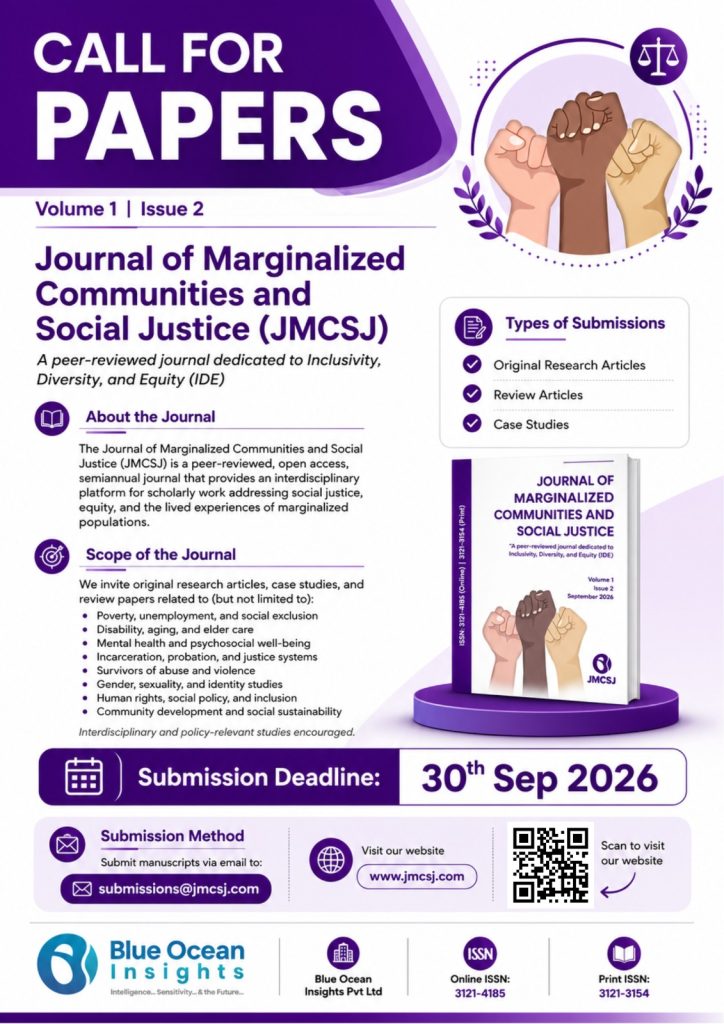
The Journal of Marginalized Communities and Social Justice (JMCSJ) is pleased to invite scholars, researchers, practitioners, policymakers, and postgraduate students to submit manuscripts for Volume 1, Issue 2.
JMCSJ is a peer-reviewed, open-access, semiannual journal dedicated to advancing interdisciplinary scholarship on marginalization, social justice, inclusion, diversity, equity, and the lived experiences of marginalized communities.
We welcome submissions in areas including:
* Poverty, unemployment, and social exclusion
* Disability, ageing, and elder care
* Mental health and psychosocial well-being
* Incarceration, probation, and justice systems
* Survivors of abuse and violence
* Gender, sexuality, and identity studies
* Human rights, social policy, and inclusion
* Community development and social sustainability
Accepted submission types:Original Research Articles | Review Articles | Case Studies
📅 Submission Deadline: 30 September 2026
📧 Submit manuscripts to: submissions@jmcsj.com
🌐 Journal website: www.jmcsj.com
We particularly encourage interdisciplinary, community-based, comparative, and policy-relevant research that contributes to meaningful dialogue, inclusive knowledge production, and positive social change.
Please share this call with researchers and professionals whose work aligns with the scope of JMCSJ.
Closed: 07 May 2026
Call for Papers – Volume 01 | Issue 01
The Journal of Marginalized Communities and Social Justice (JMCSJ) is pleased to announce the Call for Papers for Volume 01 | Issue 01. JMCSJ is a peer-reviewed, open access, semiannual journal dedicated to advancing scholarship on inclusivity, diversity, equity, and social justice through interdisciplinary research and critical academic dialogue.
We invite original research articles, review papers, and case studies that address contemporary issues related to marginalized communities and underrepresented populations. The journal welcomes submissions in areas including poverty, unemployment, social exclusion, disability, aging and elder care, mental health and psychosocial well-being, incarceration and justice systems, survivors of abuse and violence, gender and identity studies, human rights, social policy, inclusion, and community development.
JMCSJ particularly encourages interdisciplinary, policy-relevant, and socially impactful studies that contribute to evidence-based understanding and practical solutions for vulnerable populations across local and global contexts.
This inaugural issue aims to create a meaningful academic platform for scholars, researchers, professionals, and practitioners committed to social transformation and inclusive knowledge production.
Types of Submissions: Original Research Articles, Review Articles, Case Studies
We warmly welcome your scholarly contributions to this important academic initiative.